
 Share
ShareTrampoline Park Design and Safety Operations: Layout, Courts, Staffing and Maintenance
Trampoline parks look simple from the outside: a warehouse, a grid of beds, a queue of teenagers. In practice they are the most operationally demanding attraction in family entertainment. Injury rates run higher than soft play, insurance underwriters ask hard questions, and revenue depends almost entirely on how many jumpers you can safely cycle through per hour. Design and operations are the same problem seen from two angles.
This article covers how to lay out a park, which court types actually earn their floor area, how to staff the floor, and what a maintenance schedule should look like week by week.
1. Space, height and floor requirements
A viable commercial trampoline park needs 800 m2 minimum. Below that you cannot fit enough court variety to justify a 60 to 90 minute ticket, and jumpers get bored in 25 minutes. The sweet spot in Vietnam is 1,200 to 2,500 m2.
- Clear ceiling height: 5.0 m minimum above the bed surface for standard courts. Free jump and dodgeball are workable at 5.0 m. Slam dunk and performance courts want 5.5 to 6.0 m. Ninja towers and drop slides need 6.5 m or more.
- Floor loading: 500 kg/m2 is a safe target for the frame zones. Always get written confirmation from the building owner. A dynamic load from 40 people jumping in phase is not the same as a static retail load.
- Column spacing: columns inside a court grid are the single worst structural constraint. A 12 m by 12 m clear span is the practical minimum for a main free jump grid.
- Ventilation: allow 25 to 35 m3 per hour of fresh air per person at peak occupancy. Trampoline parks generate far more heat and humidity per visitor than any other indoor attraction.
2. Court types and how to allocate floor area
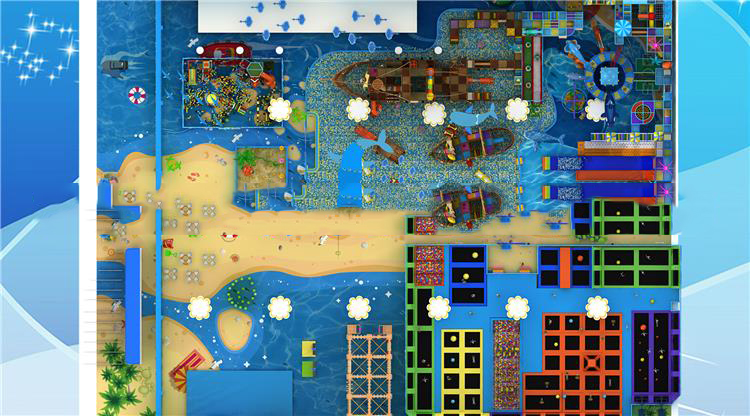
Not every court earns its space. The table below shows a proven mix for a 1,500 m2 park.
| Court type | Area | Share | Why it earns its space |
|---|---|---|---|
| Main free jump grid | 400 – 500 m2 | 30% | Highest throughput, absorbs the crowd at peak |
| Foam pit and airbag | 150 – 200 m2 | 12% | Highest perceived value, drives social video |
| Dodgeball court | 120 – 160 m2 | 10% | Group and corporate bookings, staff-led sessions |
| Slam dunk lanes | 60 – 90 m2 | 5% | Cheap per m2, extremely high repeat use by teens |
| Ninja and obstacle course | 150 – 250 m2 | 13% | Differentiator, works for adults, supports leagues |
| Toddler or junior court | 100 – 150 m2 | 8% | Unlocks weekday morning trade and parent spend |
| Battle beam, wipeout, climbing wall | 100 – 150 m2 | 8% | Queue-friendly, high spectator value |
| Circulation, cafe, party rooms, back of house | 200 – 300 m2 | 14% | Where the margin actually lives |
Two design rules matter more than the mix itself. First, never place a foam pit or airbag landing zone where jumpers approach from more than one direction. Second, keep every court visible from a single elevated supervision point so a duty manager can read the whole floor in one sweep.
Safety-critical construction details
- All frame edges and springs must be covered with foam pads of at least 30 mm compressed thickness, with no exposed steel anywhere a body can reach.
- Beds should be 6 mm polypropylene mesh with UV-stable weave, tensioned by galvanised springs rated for at least 250,000 cycles.
- Perimeter safety netting: minimum 2.5 m high, mesh aperture under 30 mm so fingers cannot pass through.
- Foam pit cubes need a fire-retardant certificate and a minimum pit depth of 1.0 m with a mesh-and-spring floor underneath, not a solid base.
- Landing and transition zones around the grid should be covered with impact-attenuating surfacing. EPDM safety flooring at the correct thickness is the standard choice for walkways and around ninja obstacles.
WINAM manufactures trampoline park courts, foam pit systems, ninja obstacles and EPDM safety surfacing in Ho Chi Minh City, which means frames, netting and pad replacements can be re-ordered locally instead of waiting on an import cycle.
3. Staffing the floor
Staffing is where most operators quietly cut corners and where insurers look first after an incident.
| Zone | Supervision ratio | Notes |
|---|---|---|
| Main free jump grid | 1 court monitor per 30 – 40 jumpers | Never fewer than two on the grid when open |
| Foam pit / airbag | 1 dedicated monitor at all times | Controls one-in, one-out entry |
| Ninja / obstacle | 1 per course | Must be able to spot and stop a run |
| Toddler court | 1 per 20 children | Parents supervise but staff enforce age split |
| Reception and waiver desk | 2 at peak | Queue speed directly caps revenue |
A 1,500 m2 park at weekend peak typically runs 10 to 14 people on shift: 6 to 8 court monitors, 2 reception, 1 cafe, 1 duty manager, plus a party host per active party. Weekday morning can drop to 4 or 5. Payroll should land at 18 to 24 percent of revenue.
Every court monitor needs documented training on the park rules, incident reporting, first aid basics and how to escalate. Rotate monitors between courts every 30 to 45 minutes. Attention decays fast on a repetitive supervision task, and most incidents happen in the last 15 minutes of an unrotated shift.
4. Rules that actually reduce injuries
Long rule lists get ignored. Enforce a short set consistently instead.
- One person per bed. The single most important rule. Double bouncing causes a large share of lower-limb fractures, and the risk rises sharply when jumpers differ in weight by more than 20 kg.
- No somersaults or flips outside designated foam pit and airbag zones.
- Land on two feet, on the bed, not on the pads. Pads are protection, not landing surfaces.
- Grip socks compulsory. Sell them, do not lend them.
- Empty pockets, remove jewellery, tie back long hair.
- Age and size separation. Under-6 sessions must be physically separated from teen free jump, not just time-separated.
- Session capacity cap. Publish a hard number of jumpers per session and hold to it even on a busy Sunday.
Run a mandatory 3-minute safety briefing video at the waiver desk, and have monitors give a 30-second verbal reminder at the start of each session. Log every incident, however minor. A clean, complete incident log is what keeps your premium renewable.
5. Maintenance schedule
Daily, before opening
- Walk every court. Check for torn beds, loose or missing springs, gaps between pads.
- Check netting attachment points and clip integrity.
- Verify foam pit fill level. Cubes compress and migrate; top up when depth falls below 90 cm.
- Test emergency lighting, first aid kit contents, defibrillator status.
Weekly
- Tension check on a sample of 20 percent of beds; rotate which section is sampled.
- Inspect all ninja obstacle fixings, ropes and hanging hardware.
- Deep clean and fluff the foam pit; remove debris and lost items.
- Check EPDM and walkway surfacing for lifted edges or worn patches.
Monthly
- Full spring audit. Replace any spring showing elongation over 5 percent of original length.
- Torque check on structural bolts across the frame grid.
- Pad foam compression test. Pads that no longer rebound must be replaced.
- Review incident log for patterns by court, time of day and staff shift.
Quarterly and annually
- Quarterly: replace 10 to 15 percent of foam pit cubes; they degrade continuously.
- Annually: independent structural and safety inspection by a competent third party, with written report.
- Annually: budget 6 to 9 percent of the original equipment value for replacement beds, springs, pads and netting. Confirm with your supplier at the design stage that these consumables will remain available; WINAM keeps bed and pad specifications in local production so a park built in year one can still be repaired to the same spec in year seven.
6. The economics in one paragraph
A 1,500 m2 park in Vietnam costs roughly USD 400,000 to 700,000 to build out, or 10 to 18 billion VND. Tickets run 120,000 to 220,000 VND per hour depending on day and session. At 55 to 70 percent weekend capacity utilisation and healthy party and group business, expect USD 380,000 to 650,000 annual revenue and 25 to 32 percent EBITDA margin, giving payback in 30 to 42 months. Parks that skimp on supervision or maintenance do not fail because of one accident; they fail because their reputation and insurance costs move in the wrong direction at the same time.
Need help planning your project?
WINAM engineers provide a free site survey, layout design and full quotation within 24 hours.
Call now: 0931 176 176
Call now: 09 6161 0202
Request a quotation
Chat on Zalo