
 Share
ShareDesigning Resort Kids Clubs and Play Areas That Raise Guest Satisfaction and Length of Stay
Family travel is the fastest-growing segment in Vietnamese leisure hospitality, and the deciding factor for a family choosing between two resorts of similar price is rarely the room. It is whether the children will be occupied. A properly designed kids club converts a two-night booking into a four-night booking, lifts average daily rate and produces the repeat guests that keep a coastal resort profitable outside peak season.
Space per child
Undersized kids clubs are the most common design failure in Vietnamese resorts. International practice and local norms converge on these planning figures.
| Zone | Area per child |
|---|---|
| Indoor supervised activity room | 2.5 – 3.5 m2 |
| Indoor soft play structure | 3.0 – 4.0 m2 |
| Toddler zone (under 3) | 2.0 – 2.5 m2 |
| Outdoor playground | 7 – 12 m2 |
| Teen lounge and games zone | 3.0 – 4.5 m2 |
A 200-key resort with 45 percent family mix and 1.6 children per family room carries roughly 145 children in house at peak. Peak simultaneous use is 18 to 25 percent of children in house, so plan for 26 to 36 at once. At 3 m2 per child indoors that is 80 to 110 m2 of activity space, plus circulation, toilets, storage, buggy parking and a staff station, giving a realistic indoor total of 140 to 190 m2 and an outdoor playground of 250 to 400 m2.
Indoor and outdoor zoning
Vietnam’s climate makes a single-mode facility a mistake. Between 11:00 and 15:30 outdoor play is uncomfortable for most of the year, and the rainy season removes outdoor capacity for weeks in the central and southern regions.
- Indoor core: soft play, craft tables, reading corner, cinema nook, toddler pen, child-sized toilets and a check-in desk with sightlines across the room.
- Covered transition: a shaded veranda of 40 to 80 m2 usable in light rain, giving a heat buffer between air conditioning and full sun.
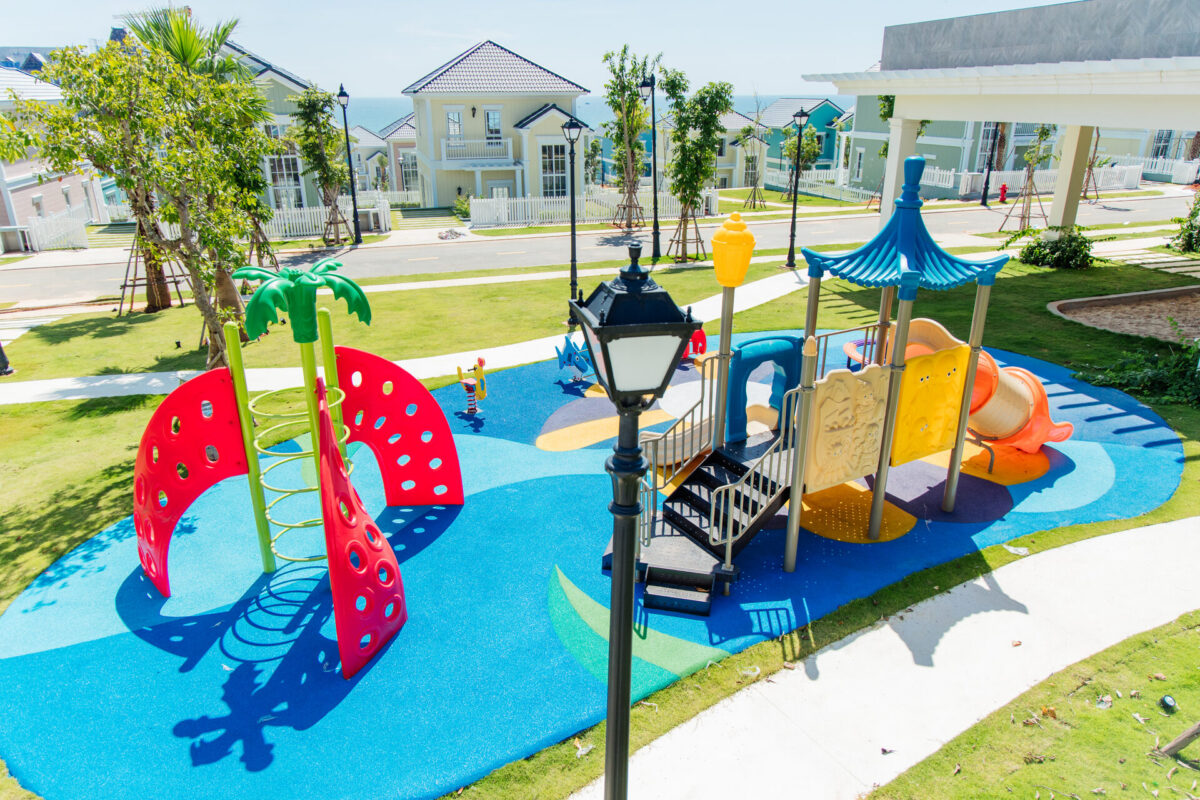
- Outdoor zone: multiplay structure, swing bay, sand or water play, climbing net and turf. Shade should cover at least 60 percent of the outdoor area.
WINAM designs and supplies both indoor soft play systems and outdoor multiplay structures for hospitality projects, letting a resort keep one specification and one maintenance regime across both zones.
Age bands
- 0 – 3 years: parent-accompanied only. Low soft forms, no elevated platforms, no small parts.
- 4 – 7 years: the core audience. Soft play, crafts, costume and story programming.
- 8 – 12 years: adventure play, sports, treasure hunts, cooking and eco activities. Without higher physical challenge they leave within twenty minutes.
- 13 – 17 years: a separate teen zone with consoles, pool table and social seating. Teenagers avoid rooms containing toddlers.
Supervision ratios
| Age band | Staff to children |
|---|---|
| Under 3 (parent present) | 1:4 |
| 3 – 4 years | 1:6 |
| 5 – 7 years | 1:8 |
| 8 – 12 years | 1:10 to 1:12 |
| Water-adjacent activity | 1:5 plus a dedicated lifeguard |
Two staff must be on duty whenever the club is open, regardless of how few children attend, so no employee is ever alone with a child and one can escort a child to the toilet without leaving the room unsupervised. A 200-key resort typically runs four to six kids club staff plus a supervisor.
Safety and liability
- Impact-attenuating surfacing under every item with a fall height above 600 mm. EPDM at 30 to 50 mm for critical fall heights up to 1.5 m.
- Equipment certified to EN 1176 and surfacing to EN 1177, with certificates retained for insurance.
- Single controlled entry, with a wristband system matching each child to a guardian and room number.
- No gaps between 89 mm and 230 mm anywhere in the structure, to prevent head entrapment.
- Incident log, first aid kit, one paediatric first aider per shift, and allergy notes captured at registration.
- Daily visual inspection, monthly functional inspection and annual third-party inspection. This record protects the resort in a liability claim.
Wet areas and pool adjacency
Proximity to the family pool is commercially valuable because parents want to see the club from their sun lounger, but it must be managed. Keep a barrier at least 1.2 m high with self-closing, self-latching gates between any play area and open water. Provide a rinse shower and changing area at the boundary so children do not carry sand and chlorine into indoor soft play, which shortens fabric life dramatically. Zero-depth splash pads are safer than a shallow pool inside the club footprint, and their recirculation should include UV or ozone treatment.
Materials for tropical and coastal sites
Salt air within 500 metres of the shoreline destroys standard playground hardware in two to three years.
- Hot-dip galvanised steel with polyester powder coating, or 304 and 316 stainless fixings within 200 m of the sea.
- HDPE panels rather than plywood or painted MDF, unaffected by humidity and colourfast under UV.
- UV-stabilised rotomoulded polyethylene for slides, in light colours to keep surface temperature below the burn threshold.
- Ropes with a galvanised steel core inside a polyester sheath, not natural fibre.
- Drainage under all surfacing at minimum 1 percent fall, sized for tropical downpours.
- Avoid untreated timber; use composite or HPL boards where a timber look is required.
Budget ranges
| Scope | USD | VND |
|---|---|---|
| Compact indoor club, 80 – 120 m2 | 35,000 – 70,000 | 0.9 – 1.8 billion |
| Full indoor club, 150 – 200 m2 | 80,000 – 160,000 | 2.1 – 4.2 billion |
| Outdoor playground, 250 – 400 m2 | 45,000 – 120,000 | 1.2 – 3.1 billion |
| Splash pad, 100 – 150 m2 | 60,000 – 130,000 | 1.6 – 3.4 billion |
| Teen zone, 60 – 90 m2 | 20,000 – 45,000 | 0.5 – 1.2 billion |
Annual operating cost runs at 8 to 12 percent of capital expenditure for maintenance, consumables and replacement parts, on top of payroll.
Effect on ADR, bookings and repeat rate
Resorts that add a properly programmed kids club typically report a 6 to 12 percent uplift in average daily rate on family room types, because the club justifies a positioning premium and reduces rate sensitivity. Family segment mix commonly rises by 10 to 20 percentage points within two seasons, and average length of stay increases by 0.5 to 1.2 nights, the largest single contributor to incremental revenue since it also captures extra food, beverage and spa spend. Repeat booking rates among families often move from 12 to 18 percent up to 25 to 35 percent, because children lobby to return to a place they remember. Payback measured on incremental room revenue alone is generally 18 to 30 months for a mid-scale resort.
The facilities that fail are those treated as a storage room with toys in it. The ones that work are designed with real area per child, honest supervision ratios, correct coastal materials and a daily activity programme. Owners planning a new build or refurbishment usually get the best result by fixing the operating model first, then specifying equipment with a supplier such as WINAM able to cover indoor, outdoor and wet zones in one coordinated package.
Need help planning your project?
WINAM engineers provide a free site survey, layout design and full quotation within 24 hours.
Call now: 0931 176 176
Call now: 09 6161 0202
Request a quotation
Chat on Zalo