
 Share
ShareHow to Plan a Profitable Indoor FEC in Vietnam: Area, Zoning, Budget and ROI
An indoor Family Entertainment Center (FEC) is one of the few retail formats still expanding in Vietnam while fashion and electronics floor space shrinks. Mall landlords in Ho Chi Minh City, Hanoi and secondary cities such as Can Tho, Bien Hoa and Hai Phong are actively courting operators because an FEC drives dwell time, food and beverage spend and weekend footfall. But the format punishes sloppy planning: get the area, zoning or throughput wrong and the payback period doubles.
This guide walks through the numbers a serious investor needs before signing a lease: how much floor area to take, how to zone it, what the fit-out really costs, and what revenue per square metre you can realistically defend.
1. Choosing the right floor area
The most common mistake is taking a space that is too small to justify the fixed cost base. Below roughly 500 m2 you still pay for a ticketing desk, a manager, a cafe corner, CCTV and a POS system, but you cannot host birthday parties at scale or offer enough variety to earn repeat visits.
| Format | Net play area | Typical location | Capacity (peak) |
|---|---|---|---|
| Neighbourhood soft play | 300 – 600 m2 | Community mall, ground floor of an apartment block | 80 – 150 children |
| Standard mall FEC | 800 – 1,500 m2 | Level 3 to 5 of a regional mall | 250 – 450 visitors |
| Destination FEC | 2,000 – 4,000 m2 | Anchor position, mixed-use development | 600 – 1,200 visitors |
Add 15 to 20 percent on top of the net play area for circulation, reception, lockers, toilets, storage and staff back-of-house. A 1,000 m2 gross lease typically yields around 800 to 850 m2 of usable attraction area.
Ceiling height decides what you can sell. Under 3.5 m you are limited to toddler soft play and role play. At 4.5 m you can install a three-level play structure. Above 6 m you unlock ninja towers, drop slides, sky trails and trampoline zones, which are the attractions that let you charge a premium ticket.
2. Zoning: designing for two spending decisions
Every FEC has to serve two customers at once: the child who decides where to go, and the parent who decides how long to stay and how much to spend. Good zoning separates age groups by noise and risk level while keeping sightlines open so a parent seated in the cafe can see their child.
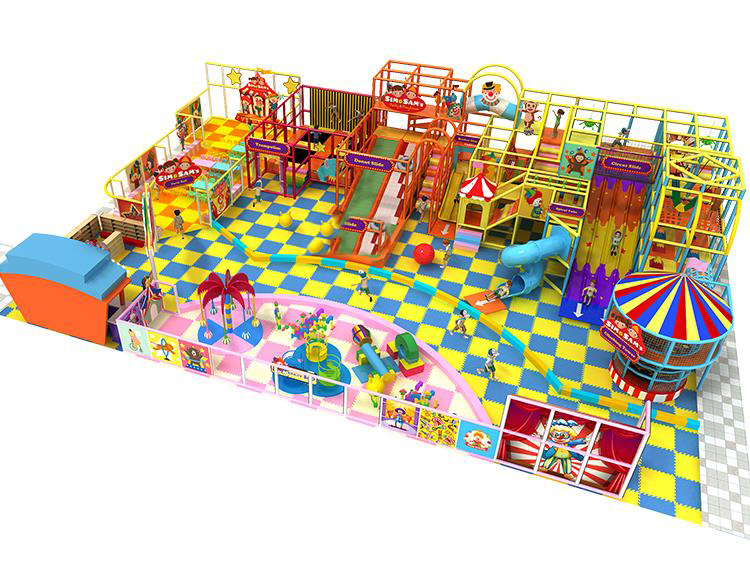
Recommended zone mix for a 1,000 m2 FEC
- Toddler zone (0 – 3 years), 12 to 15 percent: soft play blocks, ball pool, sensory panels, low slides. Fenced, shoe-free, padded floor. This zone generates the highest repeat visit frequency because parents of toddlers come on weekdays.
- Main play structure (4 – 12 years), 30 to 35 percent: multi-level structure with tube slides, obstacle nets, rope bridges. This is the visual anchor and the photo backdrop that drives social media reach.
- Active and sports zone, 15 to 20 percent: trampolines, ninja course, climbing wall, football cage. Higher ticket, older children, longer sessions.
- Role play and quiet zone, 10 to 12 percent: mini supermarket, doctor clinic, kitchen, construction site. Low capital cost per square metre and very strong with the 3 to 7 age band.
- Arcade and redemption, 10 to 15 percent: the highest revenue per square metre in the entire venue and the main driver of secondary spend.
- Party rooms, 8 to 10 percent: two to three rooms of 25 to 35 m2. Birthday packages routinely contribute 20 to 30 percent of total revenue.
- Cafe and parent lounge, 8 to 10 percent: seating with power sockets and clear sightlines. Parents who are comfortable stay longer.
Keep the circulation loop one-directional where possible so visitors pass every zone at least once. Put the arcade and the retail counter on the exit path, never at the entrance.
3. Budget: what the fit-out actually costs
Costs below are for a 1,000 m2 mall FEC in Vietnam, delivered turnkey, excluding rent deposit and working capital. Figures assume equipment supplied by a domestic manufacturer such as WINAM rather than imported finished units, which typically saves 25 to 35 percent versus European brands.
| Line item | USD | VND (approx.) | Share |
|---|---|---|---|
| Play structure and soft play | 90,000 – 140,000 | 2.3 – 3.6 billion | 28% |
| Trampoline and active zone | 45,000 – 70,000 | 1.15 – 1.8 billion | 14% |
| Role play and themed sets | 25,000 – 40,000 | 0.64 – 1.02 billion | 8% |
| Arcade machines (new or refurbished) | 60,000 – 110,000 | 1.5 – 2.8 billion | 19% |
| Flooring (EPDM, vinyl, carpet tile) | 25,000 – 45,000 | 0.64 – 1.15 billion | 8% |
| MEP, lighting, HVAC upgrade, fire safety | 40,000 – 65,000 | 1.02 – 1.66 billion | 12% |
| Theming, signage, branding | 15,000 – 30,000 | 0.38 – 0.77 billion | 6% |
| POS, RFID wristbands, CCTV, IT | 12,000 – 20,000 | 0.31 – 0.51 billion | 5% |
Total realistic range: USD 312,000 to 520,000, or roughly 8 to 13.3 billion VND. That works out to USD 310 to 520 per square metre. Anything quoted below USD 250 per m2 usually means thin steel, non-certified foam or second-hand arcade stock that will fail within two years.
4. Revenue model and revenue per square metre
A healthy Vietnamese mall FEC of 1,000 m2 should target the following annual mix:
- Admission tickets: 45 to 55 percent of revenue. Weekday 90,000 – 150,000 VND, weekend 150,000 – 250,000 VND per child for a two-hour session.
- Birthday parties and group bookings: 20 to 30 percent. Package price 4 to 12 million VND for 15 to 25 children.
- Arcade and redemption: 12 to 20 percent.
- Food, beverage and retail: 8 to 15 percent.
- Memberships and prepaid cards: 5 to 10 percent, and the single best predictor of survival in year two.
Benchmark revenue per square metre in Vietnam runs from USD 180 to 320 per m2 per year for a neighbourhood venue and USD 350 to 600 per m2 per year for a well located mall FEC. A 1,000 m2 venue at USD 420 per m2 generates about USD 420,000, or roughly 10.7 billion VND per year.
Operating cost structure
- Rent: 18 to 25 percent of revenue. Above 28 percent the model rarely works.
- Payroll: 18 to 22 percent. Staffing ratio of one supervisor per 25 to 30 children in play areas.
- Utilities: 5 to 8 percent, dominated by air conditioning.
- Marketing: 5 to 8 percent in year one, 3 to 5 percent afterwards.
- Maintenance and parts replacement: 3 to 5 percent.
A disciplined operator lands at 22 to 30 percent EBITDA margin. On a USD 400,000 fit-out with USD 420,000 revenue and 26 percent margin, annual EBITDA is about USD 109,000, giving a payback of roughly 44 months. Strong venues in high-traffic malls with heavy party business reach payback in 24 to 30 months.
5. Practical planning checklist
- Verify floor loading with the landlord before designing any trampoline or climbing structure.
- Confirm HVAC capacity. Vietnamese malls often size cooling for retail, not for 300 running children.
- Insist on fire-retardant foam and PVC certification for every soft play component.
- Design the party rooms with their own door so a party can run while the main floor is at capacity.
- Order equipment 90 to 120 days before handover. Custom steel and moulded slides need lead time.
- Budget 5 to 8 percent of the original capital cost each year for refresh. An FEC that looks identical after three years loses its members.
WINAM has manufactured indoor playground, trampoline and FEC equipment in Ho Chi Minh City since 2012, working with mall operators and independent investors across Vietnam and export markets. Working with a domestic manufacturer shortens lead times, keeps spare parts available, and makes it far easier to phase a refresh without importing a full container.
Conclusion
The FEC format rewards operators who plan around throughput and dwell time rather than around the biggest possible play structure. Get the area right for your catchment, zone for two customers, keep rent below 25 percent of revenue, and reinvest a fixed slice of capital every year. Those four disciplines separate the venues that pay back in under three years from the ones that quietly close in year two.
Need help planning your project?
WINAM engineers provide a free site survey, layout design and full quotation within 24 hours.
Call now: 0931 176 176
Call now: 09 6161 0202
Request a quotation
Chat on Zalo